Lab Methods / RECIPE LAB
SNAP-8 Dilution Reference
Ingredient amounts and method notes from the supplied reference cards.
Formula reference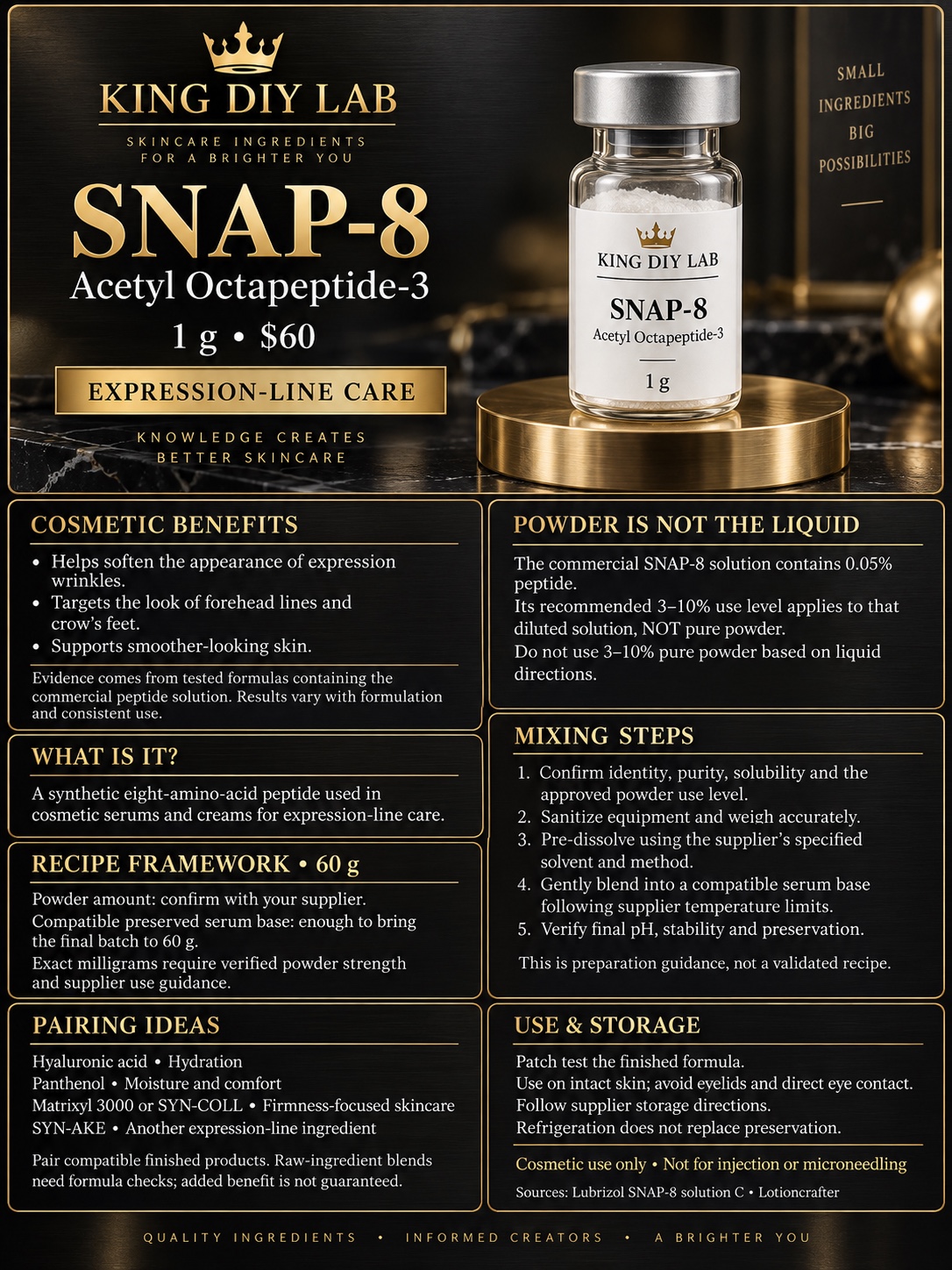
Ingredient photo · see the formula status and amounts below.
Build your reference sheet
100 mg source examplesFollow the stated batch size and recipe notes. Tick ingredients as you prepare your checklist. Changing units does not change the formula.
| Reviewed | Ingredient | Amount |
|---|---|---|
| SNAP-8 supplied powder | 0.1 g | |
| Water or compatible serum base · example A | 1 mL in source | |
| Water or compatible serum base · example B | 2 mL in source | |
| Water or compatible serum base · example C | 5 mL in source |
Recipe shopping list
Pack quantities follow the reference amounts above. Tick items you already have. Confirm the formula before purchasing.
| Have it | Ingredient needed | Shop packs |
|---|---|---|
| SNAP-8 supplied powder 0.1 g | Source separately / confirm specification | |
| Water or compatible serum base · example A 1 mL in source | Source separately / confirm specification | |
| Water or compatible serum base · example B 2 mL in source | Source separately / confirm specification | |
| Water or compatible serum base · example C 5 mL in source | Source separately / confirm specification |
Selected available packs: $0.00 · Shipping calculated with your order.
Only matched products with exact mass amounts are added. Bases, water, unspecified amounts and unavailable items are excluded. Pack cost is not the cost of ingredients used.
Suggested final pH
pH guide coming soonpH guide coming soon.
Check the finished mixture
Measure after all ingredients, preservative and final water have been incorporated and the HA is fully hydrated. Use a calibrated pH meter suitable for the serum or cream, at room temperature.
If adjustment is needed, use a formula-compatible diluted pH adjuster in small, measured additions; mix and remeasure. Recheck after 24 hours at the same temperature. There is no fixed number of drops that works for every batch.
The target must fit every ingredient and the preservative. Reaching it does not establish safety or shelf life.
Confirm the target and adjuster compatibility before following the guide.
Before preparing this formula
- Source: owner-uploaded recipe cards, read 18 October 2026. Data transcribed into the Recipe Lab format.
- The gold and monochrome cards repeat the same examples and are consolidated here.
- The cards label these examples 10%, 5% and 2%. These are w/v calculations only if the FINAL solution volumes are exactly 1, 2 and 5 mL respectively. Adding powder to that amount of liquid does not establish the final volume.
- These figures are arithmetic references, not recommended pure-peptide concentrations. The exact active content and permitted use level must be confirmed.
- Sterile starting water does not make the finished preparation sterile or preserved.
- Source reference only: confirm exact material identity, active content, suitable use level, base compatibility and preservation before preparing a batch. The cards do not establish a tested shelf life.
INTERACTIVE REVIEW
Preparation outline
- STEP 01
Identify whether the supplied ingredient is pure peptide, a blend or a commercial solution.
- STEP 02
Distinguish the amount of liquid added from the final solution volume before calculating a concentration.
- STEP 03
Confirm a complete preserved formula and suitable use level before making a batch.
Use & storage
Topical cosmetic reference only. Keep away from eyes and broken skin. Not for injection, microneedling or lash application.
Confirm preservation, final pH, stability and shelf life for the complete formula. Refrigeration and patch testing do not replace formula safety assessment.
Cosmetic hygiene guidance ↗